 Go Home
Site Map
Of Bits & Bytes, Sensors & Lights.
This article is a collection of things that are often overlooked when trying to find a sensor or ECM problem. These are not the only answers to the questions but things to do or remember in addition to those other answers. It applies to pretty much all ECMs unless noted otherwise.
Warning! Always disconnect the battery before unplugging the ECM or PROM! ECM units and PROMs can also be damaged by static electricity. Transport them in Anti Static bags or a metal box to shield them. Such damage may kill the ECM outright or weaken it so it bites you later.
The #1 thing to remember about the ECM and it's sensors is that they operate at 5 VDC or less and NOT battery voltage. NEVER connect sensor lines to battery voltage. You'll fry the ECM. Shorting out the sensor lines can blow out the 5 volt regulator in the ECM. The end result is the same; you'll need a new ECM.
The #2 thing is that ECM error codes do not always point to the right thing. Error codes should only be used as a guide. This is especially true when multiple codes are set.
The black plastic carrier for the PROM is also part of the PROM socket. If you damage the carrier the PROM will not make reliable contact with the socket.
There are at least 5 types of ECM used in Fiero. You cannot move PROMs from one type to another.
Only the O2 sensor generates its own voltage. This sensor is also the only one that is grounded thru the block. Before replacing an O2 sensor check ALL the wires bolted to the block. If the O2 sensor ground return is damaged then it will appear to the ECM that either the Fuel/Air mix is way off or the O2 sensor is failed.
All other ECM sensors are isolated from the block and have a ground wire, 5 VDC wire, or both in addition to the signal return line.
87-88 4 cyl There is an additional sensor on these motors that's not listed in Haynes/Chiltons. The MAT, Manifold Air Temp, sensor is located in the intake manifold to the right of the TBI. See the Sensor QRG.
ECM Q&A
I changed the
______ sensor but it didn't help...
I have weird idle
problems. I changed all the sensors...
I changed the O2 sensor
but the ECM still says it is bad...
The mechanic says I
need a new ECM. Now What
There are 4 things that must always be checked whenever you think there is a problem with the ECM.
1. All battery cable ends must be clean and tight. The battery provides a stabilizing effect to the car electrical system as well as starting current. Replace questionable cables. Don't forget to check the small leads off the battery cables as well. In many GM cars the small positive lead provides the only connection from the battery to the rest of the car. The heavy positive lead connects only to the starter main terminal. If the small positive lead is damaged/dirty then you will have problems.
2. Test the charging system. This is more than a voltage and current test. A full test also looks for bad diodes and other problems inside the alternator. You can have this test done for free at many repair centers.
3. Check for bad auxiliary ground straps. Replace these if there is any question of their condition. The only reliable test for these is "voltage drop." Connect a digital voltmeter to CLEAN spots on the 2 devices tied by the strap. If the voltage across the strap shows more than 1.2volts DC it needs work. (If you ever see an AC voltage in a car you have a major problem.)
4. The ECM has a number of ground leads that tie directly to the engine. If any of these ground wires are damaged one of the devices effected will usually be the O2 sensor. Find all the ground wires and make sure the ends are clean and tight. Make sure the wire isn't broken inside the insulation near the terminal.
I can't stress inspection and testing of the wiring enough. If any of the ECM wires are damaged it can and usually will cause all sorts of queer results. It also has the potential to fry the ECM. For example. If the ECM ground wire to the ignition module is damaged you'll likely get intermittent EST errors setting. You can replace both the ECM and module but if you don't fix that wire you will still have the problem.
I've got an error code ____ that must mean ____ is bad.
Maaayyyybe it do and Maaayyyybe it don't. ECM codes are very often bogus. With a few exceptions DTCs should only be used as a starting point. You have to check everything. Vacuum fuel or exhaust leaks can all trip bogus codes. Again I can't stress checking wiring enough. Wire and connector problems will cause errors just as easily as anything else. Never just assume a DTC means the part it points to is bad.
I have code 44 and/or 45.
Don't forget to check for vacuum and fuel system leaks in addition to checking sensors. On V6 check the EGR plumbing very carefully.
I have code 45 showing on a 4 cylinder with DIS ignition. The Engine light comes on when has been idling a few minutes. I replaced the O2 sensor.
Check the MAT sensor located on the intake manifold to the right of the TBI. If this sensor shows any damage or is covered in carbon, it needs to be replaced. If the carbon is soft you may be able to clean it but I don't know what cleaners are safe for it. EFI spray cleaner may be safe for it. Don't use carburetor or similar cleaners.
Can you see Open/Closed Loop without a scan tool?
Yes. Source 88FSM Page 6E-5 (Ogre added) but should apply to all GM ODB1 Engine Control Modules.
Field Service Mode
If the Diagnostic terminal is grounded (Jumper ALDL pins A and B) with the engine running, the system will enter the Field Service mode. In this mode, the "Service Engine Soon" light will show whether the system is in "Open" or "Closed Loop".
In "Open Loop" the "Service Engine Soon" light flashes two and one-half times per second. (Fast Blinking)
In "Closed Loop", the light flashes once per second. (Slow Blinking) Also, in "Closed Loop", the light will stay OUT most of the time if the system is too lean. It will stay "ON" most of the time if the system is too rich.
While the system is in Field Service Mode, the ECM will be in the following mode:
1. New trouble codes cannot be stored in the ECM.
2. The "Closed Loop" timer is bypassed.
Just what sensors and controls use engine block grounds?
The only block grounded one I know of in stock Fiero applications is the O2 sensor. All other sensors and controls have direct ECM ground and/or power ties. The DIS ignition module has an ECM ground in addition to a block ground. I'm not 100% sure about the HEI ignition module but I believe it also has an ECM ground.
Why do sensors usually have direct ECM grounds and power?
One word, Reliability. The sensors all use 5 VDC or less to do their job. Ground straps on the block and body are notoriously flaky. If you have a bad power or ground line on a sensor the ECM won't read it correctly. The direct approach may increase the car's wiring but results in much more accuracy of the sensors.
Why do some things have multiple grounds?
Not all grounds are the same. While they are all technically grounds, they often aren't the same circuit. Keep in mind that electricity wants to follow the path of least resistance. It is easy to have one ground flowing 50 amps while another has almost nothing.
The ignition module is a good example of something that has to have multiple grounds. One is a signal ground and the other is a high current circuit. Both of them must be clean and secure for the ignition to work properly. (This applies to both HEI and DIS.)
The thin ground wire connected between the ECM and module insures that the timing signal from the module is read correctly. Without this wire, the timing signal would ground thru the distributor, engine block, various straps, the car body, and any other noisy dirty connections between the module and the ECM. The odds of the ECM reading a good signal drop tremendously. In fact in at least one GM TSB, they say to check this ground circuit any time a vehicle throws code 42 (Electronic Spark Timing) errors.
On the other side of the ignition module, you are switching high current (several amps) from the ignition coil to ground. This circuit needs a solid ground to the battery and alternator. If it cannot get this, it will try to ground back thru the ECM, body, various straps and whatever. All this added resistance will result in weak or no spark. It could even fry the ECM.
There are several ways to implement multiple grounds. HEI ignition modules usually use a wire for signal ground and the mounting hardware for the high current. DIS on the 87+ Fiero L4 uses two separate ground wires. Other devices could have 2 wires going to one terminal. Whatever the case, if you are altering a device then you've got to insure that all the ground circuitry is accounted for.
Then why doesn't the O2 sensor have it's own ground?
No idea. Ask GM. It makes no sense to me that the 5 volt sensors have their own grounds and power but the O2 sensor is block grounded.
I installed a header and now I have O2 sensor problems.
Try installing a NEW Bosch sensor. I've been told these will better tolerate the Hooker header on the 4 cyl.
The common thing for header users to do is replace the OE O2 sensor with one that has an ECM ground lead and/or is heated. With Headers the heated sensor is often needed because the exhaust isn't always hot enough to keep the sensor operating.
Also keep in mind that any change to the exhaust can affect the EGR system on the 4 cylinder. This can cause O2 sensor problems. The 4 cyl EGR uses exhaust back pressure and vacuum to decide when to open.
My Engine Coolant Temperature sensor is bad but the one the counter man gave me has a different connector... He says that's what the part catalog told him to get. (Or some similar thing.)
The original round connector ECT sensor used by the ECM in early Fiero and other GM cars is no longer available. The new sensor requires a new connector. This connector is included with Borg Warner packages but will need to be purchased separately with many others.
This new connector MUST be soldered to the OE wiring harness in place of the original one. If the new joints corrode even a little bit the ECM will receive bogus data that can and usually will hurt performance, often without setting any DTCs in the ECM. The instructions included with the Borg Warner sensor tell you this but most of the other ones around don't. If you buy just the connector it doesn't come with instructions either.
ECM Reset
The ECM will remember all errors until reset.
There are 2 ways to reset the ECM:
- Disconnect the battery for 30 seconds or more. This will reset the ECM, radio, and anything else using the main battery to store data.
- Use ECM "Reset connector" (C501). The connect moves depending on which engine and year/model of car. Only 84 Fiero ECM reset connector is different, Alldata/84FSM says C501-LH Rear Of Engine, IE on the motor. All other Fiero should be as shown below, C501-Near Battery Junction Block. If you undo the connection in the orange wire it will reset the ECM without wiping the radio and whatever else.
ECM "Reset connector" (C501) from 87 4 cyl...
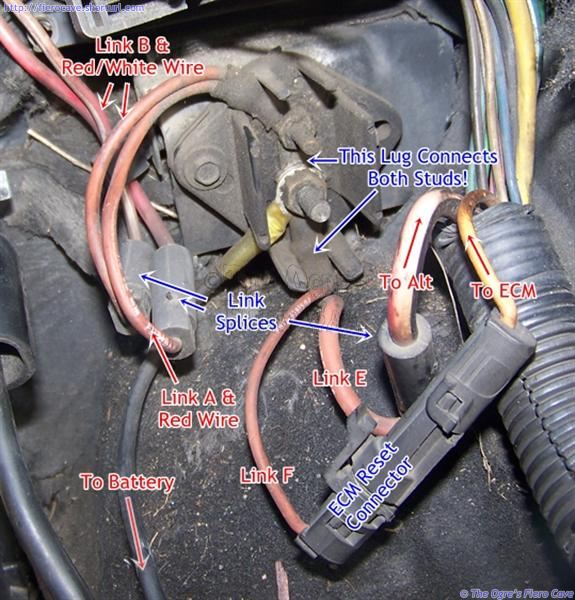
After the reset the car will run and idle weird until you go for a drive. The idle will settle down once you drive over 35 for a mile or so. The rest may take a hour of driving to really settle in. ((This assumes everything is working and you don't log more codes.))
Note: During recent experimenting with my scanner I found that the ECM reset the IAC as soon as I gave it gas for a few seconds. Now I have the DIS motor, which uses a whole different ECM design, but this may also happen for the other stock motors. The car will still need to be driven to get the ECM to relearn everything but at least the idle should settle in quick. Keep in mind though that if the engine is cold then you'll still get a high idle. Likely a little higher than normal, but it should settle the rest of the way down when it warms up while you drive.
Another Note: I've heard reports that some older ECM's may be damaged by using the orange wire reset. Personally, I think those ECM's had something wrong with them to begin with. If you are at all worried about this then just disconnect the negative battery terminal to do the reset.
ECM Replacement
Ok, I've done all that. I still think I have to replace the ECM.
Officially, and from me, you'll always be told to use the correct ECM and PROM for your year make and model. Don't whine to me if you try a different ECM or PROM and the car dies.
There are other ECM & PROM combinations that may work but the problem is if you get it wrong you could fry the engine. At the least it will have some kind of effect on power and fuel economy. If you are going to try an alternate ECM and/or PROM it's critical you have an ECM scanner to check out the installation. Ideally you want to run the car on a dyno while it's checked with various test equipment to make sure spark timing and other parameters aren't going to cause harm to the engine.
The C4 ECMs in the older 4 cylinder and all V6 cars should work as long as you get the right ECM and PROM for your engine & transmission type. It doesn't too much matter what car it was in. If you change ECM part #'s the main thing you want to worry about is that it plugs in the same way as the old one.
With manual transmissions the PROM determines when the shift light turns on. If you have a PROM from a transmission with different final gearing or number of gears (4 speed vs 5 speed) then the shift light may come on at the wrong times but the car should still run.
With Automatics you might have a problem with torque converter lockup if the wrong PROM is used. Most of the PROMs out there are for 3 speed automatic but there are plenty of AOD transmissions as well.
With the newer P4 ECMs like 1227748 used in 87-88 Fiero you have even more things to worry about. Even if the PROM comes from another car with the 2.5l DIS 4 cyl and the exact same transmission it still may not work in Fiero. This is because P4 ECMs integrate the VSS buffer circuit and the cruise control logic. The newer you get the more functions get built into the ECM/PCM unit.
Used ECM's
Need another ECM and want to find used ones? You can use ECM units out of other GM cars but you MUST make sure you have the right Fiero MEMCAL/EPROM chip for that ECM.
For example you can use the 1227748 ECM from many other 87-92 GM cars but you must use a Fiero DIS motor EPROM. If you don't the car will have problems even if the donor car had the same motor as Fiero. I tested this with an 88 2.5l Grand Am chip. The car ran but the VSS mode was wrong so it threw error 24. Put the Fiero EPROM back, reset the ECM, and no more error.
Ludis' page has a list of ECM's and what applications they are used with. He also has a single list of most of the Fiero ECM's and the chips ID'd by the chip label.
Want to learn more about the ECM?
The single best place to start rooting in is Do It Yourself EFI. You can find information on nearly every ECM ever made by GM on this site or one of the ones it has links to.
1227748 ECM 87-92 DIS 4
The 1227748 ECM can be found in cars using Vin R or U motors shown on this list.
As I mentioned above the Grand Am PROM will generate VSS errors when used in Fiero. A new feature of the 1227748 ECM causes this. This ECM can accept the VSS feed directly or as a buffered signal. Fiero uses the buffer and Grand Am is direct. The choice of which feed to use is done in the PROM. So when you put a Grand Am PROM into a Fiero the ECM selects the wrong VSS source and generates an error. The same would happen to the Grand Am if you put a Fiero PROM in it.
A major change for 87-88 4 cylinder is the elimination of the fan switch from the block. This is now controlled in the ECM and the setting is stored in the PROM. (The ECM has 2 fan outputs but only one is used in Fiero.)
Another new feature of this ECM is the inclusion of the cruise control logic. Adding cruise to this ECM is a matter of adding the servo and the turn signal stalk. In fact the interior wiring harness already has a connector to drop the cruise control wiring into. I am presently investigating this upgrade for my own use and will post details, if any, at a later date.
I am presently investigating this ECM further in hopes of expanding the PROM choices available to the 87-88 Fiero 4 cyl. I'm also hoping to find the fan control points in the PROM so that not only can the main fan be activated at a lower temperature but also the second fan circuit is useable.