 Go Home
Site Map
10 Rules For Safe Lifting
(At least...)
Warning: The trunk's latch strike is NOT to use to lift the car. Trunk latch system is not made for a lifting spot and the strike will bend even break and dropping the car. Do Not use the strike for lifting car in engine/trans swap, etc. Ignore anyone that says it's OK.
Warning! You do all lifting and blocking at your own risk!
WRONG! You do all lifting and blocking at the risk of yourself and every person that may come near the vehicle. Including family friends and children. Don't bitch at me if you do something half assed and drop a car on someone.
Neighborhood children will frequently come up to a vehicle under repair. They will even try to crawl under it to watch what you are doing. I regularly have to tell other people's children to get back when I'm doing dangerous work on a vehicle.
Your friends may know even less than you do about safe lifting. Don't trust them not to drop your own car on you.
This is ONLY a quick guide. It cannot possibly cover every lifting setup.
- If it doesn't look safe, it probably isn't.
- When it does look safe, check it again.
- If it's been out of your sight, even a few minutes, check it again. God knows who may have screwed with it in that few minutes.
Even though these rules are numbered, they are all equally important.
- ALWAYS lift on a level surface!
- NEVER get under a car supported only by a jack. All jacks are subject to possible collapse. Hydraulic jacks are the worst but any jack can fall.
- ALWAYS use Jack Stands. The best stands are the 4-legged ratchet type. Make sure the stands are rated for the vehicle in question.
- ALWAYS use skid pads under jacks and stands when working on dirt or blacktop. Without the pads, jacks and stands can sink into blacktop even on seemingly cold days. Metal plate is best but thick plywood also works as long as it has full contact under it.
- Always block the wheels that stay on the ground in both directions. If blocking only one wheel, block the one with the most load in it.
- NEVER use any kind of Cement, Concrete, Clay/Red Brick, Rock, or similar brittle materials for blocking. Such materials are extremely easy to shatter when unevenly loaded.
- Wood Blocks should be loaded across the grain, especially if the contact area is narrow.
- When stacking wood blocks, alternate the grain direction.
- Ramps must never be used on dirt or blacktop without skid pads. Many Steel ramp designs can sink into backtop or cut thru plywood. Plastic ramps are light and spreads the load over a big area.
- NEVER "Take a run" at a set of ramps. Ramps can and will fly out if loaded suddenly or off center. If you have trouble climbing ramps, buy ramp extension blocks. These products reduce the total slope of the ramps. They are available at many of the same places that sell ramps.
Rust
After seeing this article Gordo in the forums had this to say:
I just read your article and I couldn't agree more. Safety should be everyone's first concern. One point that I think needs to be mentioned though is that these cars are going on 20 years old and some of the areas (such as the jack stand areas on each side of the trunk) may be weakened with rot. Especially if you live in the great white north. I have seen a jack punch a hole through an engine cradle that looked ok on the bottom but was rotted inside. Please be sure that your lift point is sound and if it isn't, re-asses the safety of the entire car.
I used to live in NY but I've been in Delaware for some time so I didn't even think about the rust factor. Something we used to do when I lived up there was to give an intended jack point a whack with hammer. Assuming the hammer doesn't dent the frame... It shouldn't... You can often tell by the sound an area could be getting weak. (Even a 2-3 pound hammer won't dent good frame unless you beat the hell out of it.)
Jack Points
The jack points below are from the shop/retail service manuals EXCEPT the locations of the safety stands. The safety (jack) stand locations are mostly a guess as a result of poor printing. I've also added a couple spots I use when lifting only the rear of the car.
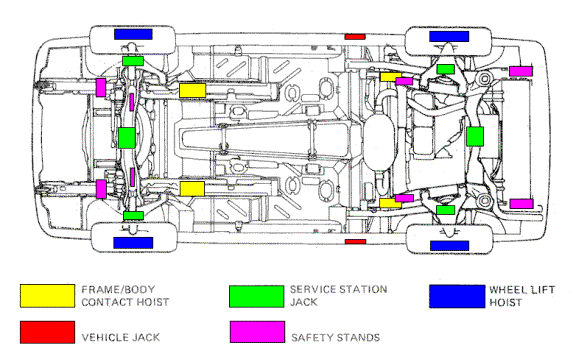
The above image is mainly a guide. It's not 100% accurate for all possible lifting you will do, especially the spots for floor jacks and jack stands. (To clarify, I think the jack stand points shown by the trunk are the frame rails not the actual trunk. It is a bit hard to tell in that picture, especially the lower one.)
Besides the strength of a lift point, the main thing with jacks and jack stands is to look at the angle of the frame spot you want to put it.
Examples:
- If you use a frame rail, you want the spot on the rail as close to parallel to the round as you can get. If it's a jack spot you want it to stay fairly parallel as it lifts.
- Hook the edge of a cross member that is, or will be, at an angle instead of putting the jack/stand in the middle of a big flat space.
- Center a frame edge between the bumps around the edge of the lift cup on a hydraulic floor jack.
The idea is to lock the top of the jack/stand so that the car won't spit it out the first time you shake it.
Cranes
AKA Cherry Picker, etc.
When using a crane, watch length on lifting arm. Always set adjustable legs
to maximum length.
Longer arm means less load arm can lift and can mean less stable when lifting
high.
Many cranes are label but some don't have them or label has worn off.
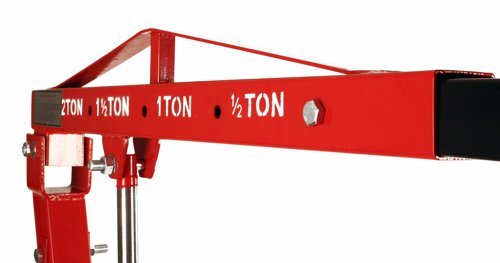
Example from enginehoist.net
Most Crane's load rate as advertised is Maximum load and means shortest arm. Harbor Freight and others 1 ton crane is only rated 500Lb when arm is at maximum length. Too low for safe lifting a Fiero rear w/o cradle etc.